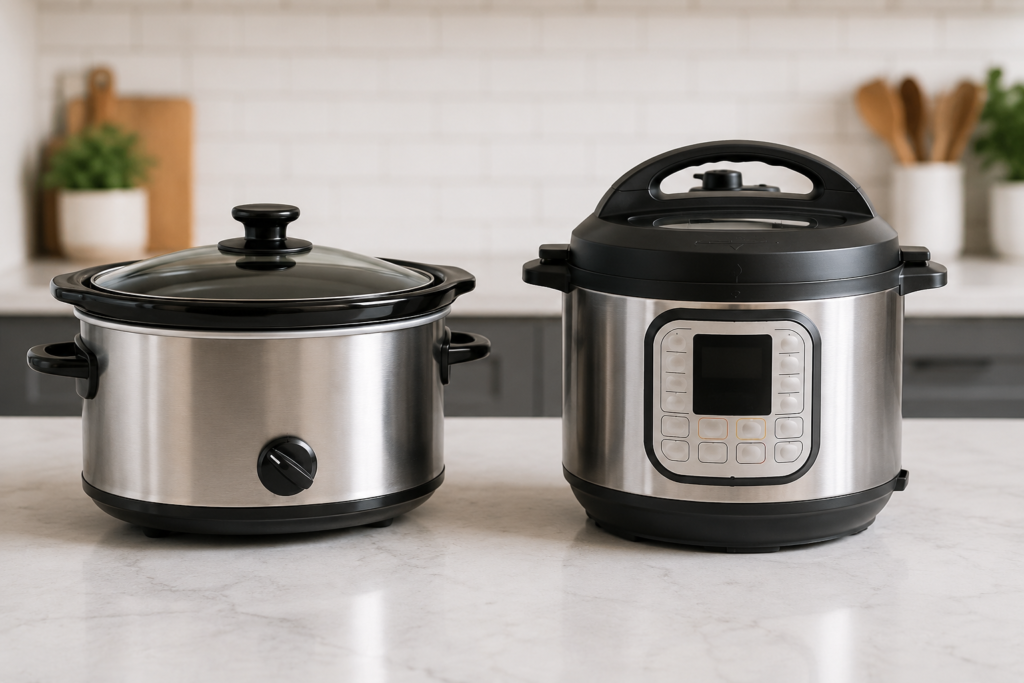
The slow cooker vs Instant Pot debate is one of the most genuinely useful kitchen appliance comparisons any home cook can make. According to the American Heart Association’s healthy cooking guidance, both slow cooking and pressure cooking preserve significantly more nutrients in vegetables and proteins than high-heat stovetop and oven methods — with pressure cooking retaining water-soluble vitamins particularly well due to the shorter cooking duration that reduces nutrient degradation over time. So nutritionally, you are making a good choice either way. The real question is which one fits your actual life — your schedule, your cooking style, your comfort with kitchen technology, and the specific dishes you want to make more easily and more often.
Here is the thing about this debate that most comparison articles miss: the slow cooker and the Instant Pot are not actually competing for the same job. They are fundamentally different appliances that happen to both produce tender, flavorful food from the same ingredients. Understanding what makes each one genuinely useful — and genuinely limited — is what allows you to make a decision you will not regret six months later when one of them is gathering dust in the back of a cabinet.
Understanding What Each Appliance Actually Does
Before comparing them directly, it helps to understand the core mechanism of each appliance, because the mechanism explains everything else.
A slow cooker is exactly what it sounds like — a low-temperature electric cooking vessel that cooks food very slowly over a long period, typically six to ten hours on low setting or three to four hours on high. The cooking temperature never exceeds the boiling point of water. The gentle sustained heat gradually breaks down connective tissue in tough cuts of meat, develops deep flavor through long cooking, and produces the fall-apart tenderness that makes slow cooker dishes so satisfying. It is passive cooking — you set it up and walk away for hours.
An Instant Pot is a multi-function electric pressure cooker that cooks food under pressure at temperatures significantly above the normal boiling point of water — typically around 120°C (250°F) in its sealed environment. This elevated temperature dramatically accelerates cooking, reducing what would take eight hours in a slow cooker to 45 minutes or less. Modern Instant Pots also function as slow cookers, rice cookers, steamers, sauté pans, and yogurt makers — making them genuinely multi-purpose appliances rather than single-function pressure cookers.
This fundamental difference in mechanism — gentle long cooking versus high-pressure fast cooking — is what drives every meaningful performance difference between them.
Slow Cooker vs Instant Pot Comparisons
Following are some Slow Cooker vs Instant Pot comparisons discussed:
Cooking Speed Comparison
This is where the Instant Pot wins comprehensively and without much debate. A beef stew that takes eight hours in a slow cooker takes about 35 minutes in an Instant Pot. A whole chicken that takes six hours low and slow takes 25 minutes under pressure. Dried beans that take eight hours overnight in a slow cooker take 25 minutes in an Instant Pot from completely dry, with no soaking required.
For home cooks whose primary motivation is freeing themselves from the time demands of traditional cooking, the Instant Pot’s speed advantage is genuinely transformative. You can decide at 6pm that you want a proper slow-braised dish and have it on the table by 7pm — an option that the slow cooker simply cannot provide for anyone who has not planned their meal that morning.
The slow cooker’s relationship with time is the opposite — its advantage is that it does not require you to be in the kitchen at all during the cooking process. You prepare everything before you leave for work, turn it on, and come home to a finished meal. This requires planning ahead but rewards that planning with genuine hands-off convenience during the hours you are least available to cook.
Speed Winner: Instant Pot, clearly. But the slow cooker’s extended cooking time is also its advantage for busy people who plan ahead — not a weakness.
Food Quality and Flavor Comparison
This is where the comparison gets more nuanced and where personal preference genuinely matters.
Slow cooker food quality
Slow cooking’s long gentle heat produces flavor development that pressure cooking genuinely cannot replicate in equivalent time. The Maillard reaction browning that you achieve by searing meat before it goes into the slow cooker, the gradual caramelization of aromatics, and the long development of sauce complexity through sustained cooking produces the deep layered flavor that makes certain dishes — beef bourguignon, pulled pork, lamb shoulder — taste like they were made by someone who has been cooking since dawn.
The low temperature also produces the specific texture that certain dishes require. A slow-cooked piece of brisket develops a particular collagen-to-gelatin conversion at low sustained temperatures that creates a texture impossible to replicate through any faster cooking method. Some dishes are simply better from a slow cooker, and experienced cooks know which ones these are.
Instant Pot food quality
The Instant Pot produces excellent results for a very wide range of dishes, and it does so quickly. Braised short ribs, risotto, soups, stews, and whole grains all emerge from the Instant Pot genuinely good — tender, flavorful, and satisfying. The sauté function means you can brown meat and aromatics in the same vessel before pressure cooking, which captures much of the flavor development that stovetop pre-cooking provides.
Where Instant Pot results occasionally fall slightly short of slow cooker equivalents is in the specific dishes that depend on the very long development time of sustained gentle heat — the extended braise where the extra six hours genuinely changes the result. For everything else, the Instant Pot’s results are excellent.
Food Quality Winner: Slow cooker for specific long-braise dishes. Instant Pot for everything else. The honest answer is a tie that depends entirely on what you cook.
Versatility Comparison
The Instant Pot wins this category decisively — and it is not particularly close.
A modern Instant Pot functions as a pressure cooker, slow cooker, rice cooker, steamer, sauté pan, yogurt maker, and in some models an air fryer. The appliance that sits on your counter can replace three to five single-function alternatives, which matters both financially and in terms of kitchen storage space. For apartment dwellers and small kitchen cooks who cannot afford to give counter or cabinet space to multiple appliances, this multi-function capability is genuinely significant.
The slow cooker does one thing extremely well and nothing else. There is no sautéing in a slow cooker without a separate pan. There is no pressure cooking, no rice cooking, no steaming. Its singular focus is both its limitation and, arguably, part of its appeal — it is the dedicated tool that does its one job brilliantly without the interface complexity that multi-function appliances require.
Versatility Winner: Instant Pot, clearly.
Ease of Use Comparison
This is where the slow cooker reclaims significant ground — and where the right answer genuinely depends on the user.
Slow cooker ease of use
A slow cooker has approximately three controls: a power switch, a high/low setting, and sometimes a keep-warm function. The operational learning curve is essentially zero. You put ingredients in, set the temperature, set a timer or mental note, and walk away. There is nothing to seal, no pressure to build, no valve to manage, and no safety protocols to learn. It is as simple as an appliance gets.
Instant Pot ease of use
The Instant Pot has a significantly steeper learning curve. The sealing valve must be properly positioned before pressure cooking. The pressure release — either quick release or natural release — requires understanding and conscious management after cooking. The various function buttons, pressure levels, and time settings require familiarity before confident use. The first few Instant Pot sessions produce a meaningful proportion of home cooks who are slightly anxious about the process — the seal, the pressure, the steam release valve.
This is not a reason to avoid the Instant Pot — the learning curve is real but short, and most users are completely comfortable after three to five uses. But for the technophobic cook, the elderly home cook, or anyone who finds kitchen technology genuinely stressful, the slow cooker’s extreme simplicity is a genuine quality-of-life advantage that the Instant Pot cannot match.
Ease of Use Winner: Slow cooker — significantly simpler to learn and use confidently from the first session.
Safety Comparison
Modern slow cookers are among the safest kitchen appliances available — low-temperature, no-pressure operation with no steam release mechanism to manage. The main slow cooker safety consideration is the obvious one: it is a hot appliance left unattended for hours, and its placement should account for this.
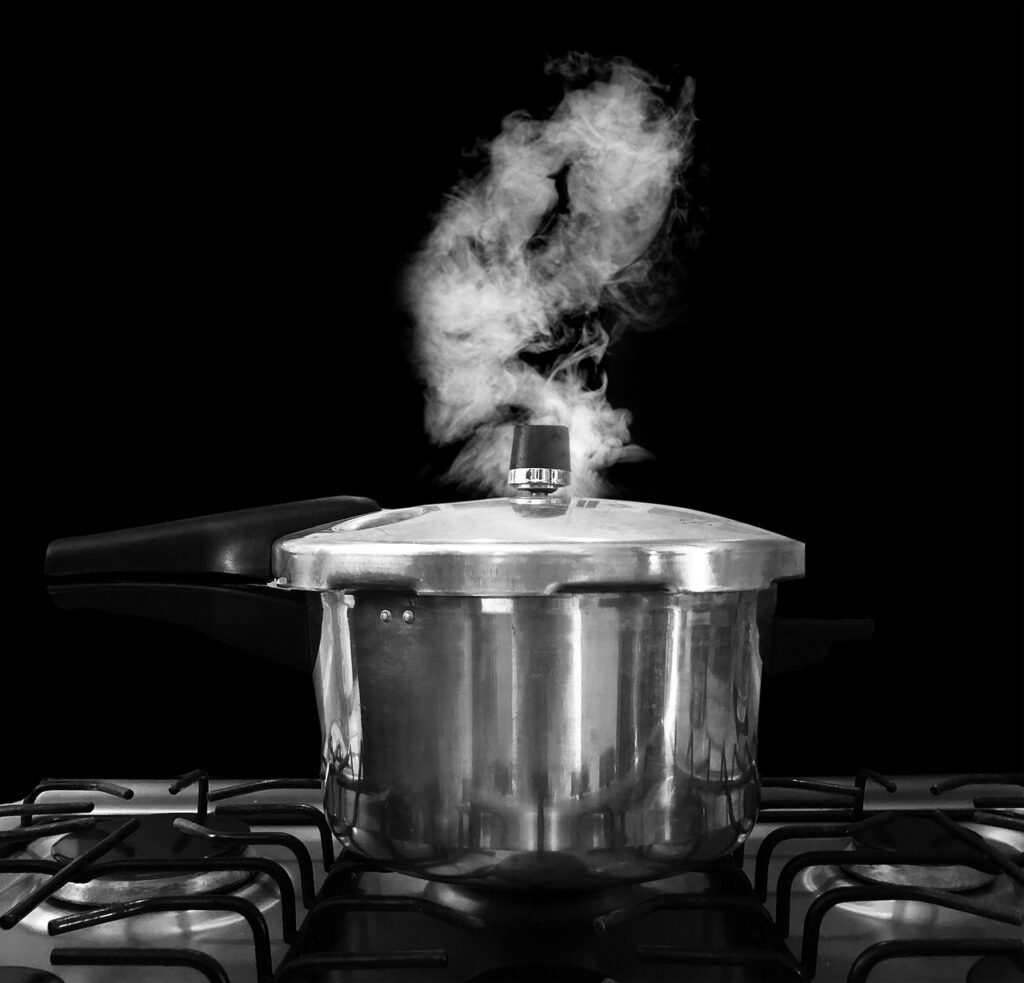
The Instant Pot’s pressure cooking mechanism understandably creates more safety awareness for first-time users. Modern Instant Pots have multiple built-in safety mechanisms — lid locking under pressure, pressure release protection, overheat protection, and temperature monitoring — that make serious accidents from normal use essentially impossible in modern models. The pressure cooking that intimidated previous generations of home cooks is genuinely safe in contemporary electric pressure cookers with their multiple redundant safety systems.
The steam release during quick pressure release is the main practical safety management point — directing the steam valve away from your face and hands. This is not complicated, but it is something you need to know about before your first use.
Safety Winner: Tie — both appliances are genuinely safe for normal use. The Instant Pot requires slightly more safety awareness but is not meaningfully more dangerous than the slow cooker when used correctly.
Energy Efficiency Comparison
Both the slow cooker and the Instant Pot are significantly more energy efficient than conventional ovens for equivalent cooking tasks. The slow cooker’s extended cooking time means it consumes energy for longer — typically six to eight hours at 150 to 300 watts. The Instant Pot cooks much faster at higher wattage — typically 700 to 1200 watts for 30 to 60 minutes — and then maintains temperature at low power.
In practice, the total energy consumption of equivalent dishes is broadly similar between the two appliances, with the Instant Pot having a slight efficiency edge for most dishes due to the much shorter active cooking time. Both are significantly cheaper to run than an oven for equivalent results.
Energy Winner: Modest edge to the Instant Pot for most dishes, but the difference in running cost is small enough that energy efficiency should not be a deciding factor between them.
Cost Comparison
Basic slow cookers start at $25 to $30 for perfectly capable entry-level models, with quality mid-range options available between $40 and $80. Instant Pots start around $70 to $80 for the entry-level models and run to $150 and above for the most feature-rich versions.
When the Instant Pot replaces multiple single-function appliances you would otherwise purchase separately — a rice cooker, a steamer, a separate slow cooker — its higher initial cost frequently represents genuine overall savings rather than a premium. If you are currently buying these appliances separately, the Instant Pot’s combined cost for all these functions is often lower than purchasing each function individually.
Cost Winner: Slow cooker for lowest initial investment. Instant Pot for better value when accounting for the multiple appliances it replaces.
Who Should Buy Each One
Buy a slow cooker if:
You regularly leave home for eight or more hours and want to return to a finished meal. You primarily cook the classic long-braise dishes — pulled pork, beef stew, pot roast — where the extended cooking time genuinely improves the result. You prefer maximum simplicity with zero learning curve. You are cooking on a tight budget and want the most capable appliance for the least money. You already have a rice cooker, steamer, and other single-function appliances and do not need them replaced.
Buy an Instant Pot if:
Your schedule does not allow for eight-hour cooking but you still want the tender results that long cooking produces. You want one appliance to replace multiple single-function alternatives and free up kitchen storage space. You cook a wide variety of dishes and want the versatility that multi-function cooking provides. You want to cook dried beans, grains, and tough cuts of meat significantly faster than any other cooking method allows. You are comfortable with a modest learning curve for significantly expanded capability.
Buy both if:
You are a serious and enthusiastic home cook who regularly makes the specific dishes where each appliance genuinely excels. Both the slow cooker and the Instant Pot are relatively affordable, and for dedicated home cooks the combined investment in both genuinely improves the quality and variety of what comes out of your kitchen.
Both the slow cooker and the Instant Pot are fundamentally meal prep appliances — tools that shift the labor of cooking away from busy weeknight evenings into planned sessions that make weeknight eating effortless. For the complete meal prep system that puts whichever appliance you choose to maximum use check out our guide on how to meal prep for the week in two hours — the system that makes healthy weeknight eating genuinely easy regardless of which cooker you choose.
Understanding what each appliance genuinely does best allows you to make the right choice for your cooking lifestyle rather than the popular choice that may not suit your actual kitchen habits at all. And if you are building out your complete kitchen with the right tools for every task check out our honest comparison of nonstick vs stainless steel cookware — another foundational kitchen decision that deserves the same careful thought this appliance comparison provides.
Frequently Asked Questions
Q: Can an Instant Pot fully replace a slow cooker?
A: Technically yes — modern Instant Pots include a slow cooker function. In practice, most Instant Pot users find that the slow cooker function on the Instant Pot does not perform quite as well as a dedicated slow cooker, with temperature management that some users find less consistent than their standalone slow cooker. If slow cooking is your primary use case, a dedicated slow cooker typically produces better slow-cooked results than the Instant Pot’s slow cooker mode. If pressure cooking is your primary use case and slow cooking is occasional, the Instant Pot’s slow cooker function is adequate.
Q: Is the Instant Pot actually safe to use?
A: Yes — modern electric pressure cookers including the Instant Pot have multiple redundant safety systems that make serious accidents from normal use essentially impossible. The lid cannot be opened under pressure, the pressure release is controlled, and the appliance monitors temperature continuously. The learning curve involves understanding these safety mechanisms rather than managing genuine danger.
Q: Which is better for a beginner cook?
A: The slow cooker is more accessible for absolute beginners because of its extreme operational simplicity. The Instant Pot is better for beginner cooks who are comfortable with slightly more complexity but want the expanded versatility and time savings that pressure cooking provides. Both produce excellent results for straightforward recipes — the question is how much operational complexity you are comfortable managing.
Q: Can I make the same recipes in both?
A: Most slow cooker recipes can be adapted for the Instant Pot with time adjustments — the same ingredients, dramatically shorter cooking times. Some recipes that specifically depend on the long development time of slow cooking produce slightly different results in the Instant Pot, but for most everyday recipes the adaptation is straightforward. Many Instant Pot recipe books provide slow cooker timing equivalents alongside pressure cooking times.
Q: Which appliance is better for cooking for one or two people?
A: Both work well for small households, but the Instant Pot’s multi-function versatility makes it particularly well-suited to single and couple households that want one appliance to do multiple jobs rather than multiple single-function appliances taking up limited kitchen space. The slow cooker makes larger batch cooking for meal prep most efficient, which suits any household size that commits to the weekly meal prep approach.
Conclusion
The slow cooker vs Instant Pot decision ultimately comes down to two questions: how much time do you have for cooking, and how much complexity are you comfortable managing in the kitchen?
If your best cooking happens when you set it and forget it for eight hours, the slow cooker is your appliance. If your best cooking happens in a 45-minute burst before dinner, the Instant Pot is yours. If you are not sure which describes you, buy the Instant Pot — its versatility means it grows with your cooking confidence and needs in a way that the single-function slow cooker cannot.
Both are genuinely excellent appliances that make home cooking better, more convenient, and more consistent. Whichever you choose, use it regularly, cook the dishes it does best, and enjoy what it adds to your kitchen life.
Explore the complete collection of kitchen guides and product reviews at BudgetKitchenPick.com — Budget Kitchen Pick Blogs Page — for honest practical advice on every kitchen appliance and cooking decision you face. And for the healthiest cooking tool you can add to your kitchen this year check out our complete guide to the best vegetable steamers for healthy cooking — 10 brilliant picks that preserve maximum nutrients and flavor in every meal.